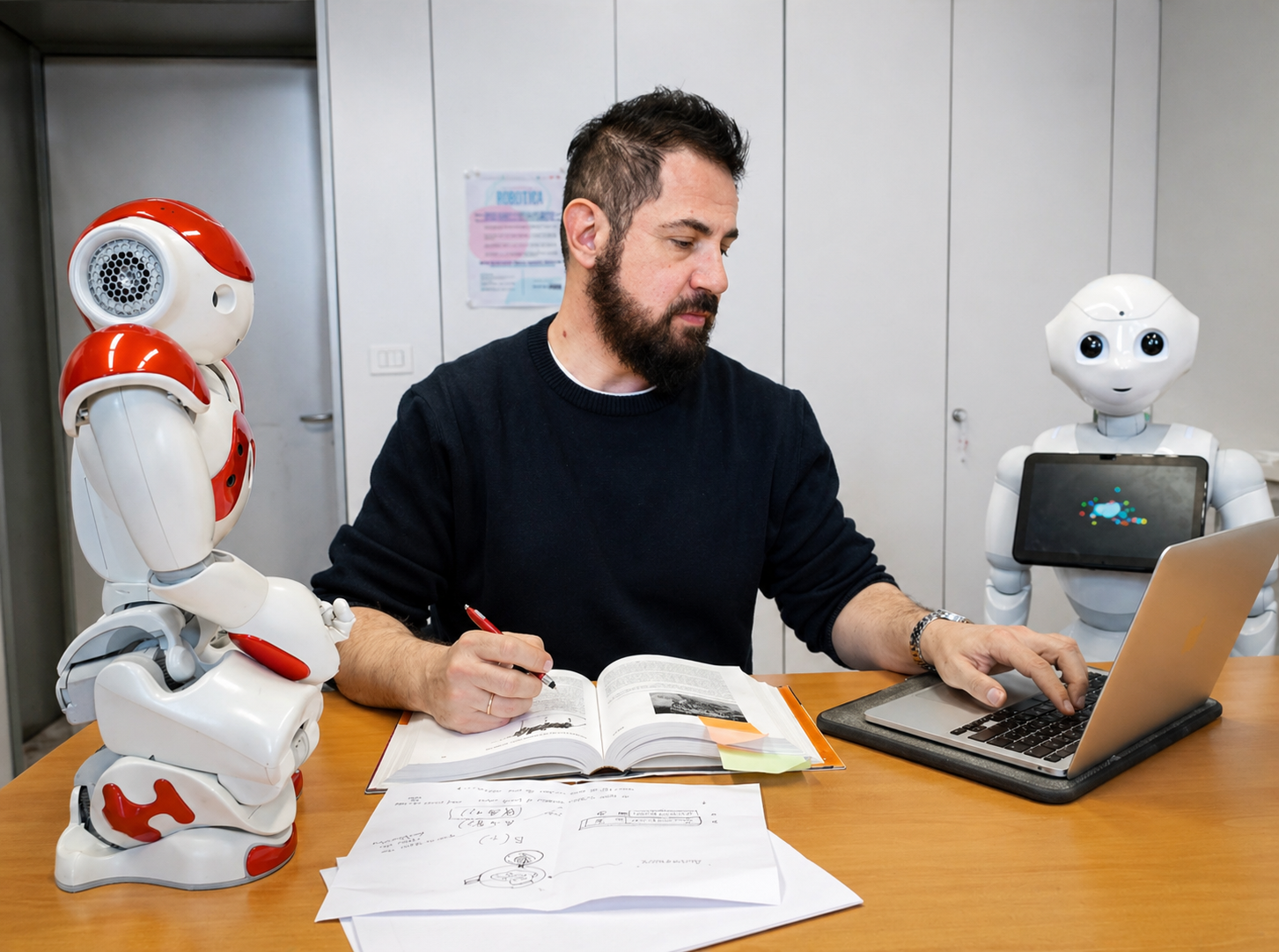
My research stems from a long-standing question about the educational contexts in which I work as a literature teacher in lower secondary school. Over time, my teaching experience has led me to explore the border areas of school, such as support and inclusion: places where relational dynamics, the issue of control, and the management of uncertainty emerge with particular intensity.
From these premises, an anthropological curiosity took shape about what happens when new actors enter the educational ecosystem. Specifically, the encounter between humans and artificial agents, such as robots, raised a series of questions about the processes of acceptance and rejection: what meanings are attributed to these mechanical agents? How are they interpreted when they enter complex human contexts, dense with expectations and established practices? My focus thus shifted from technology itself to the processes of meaning attribution that guide its use. It is in this intertwining of culture and beliefs that I encountered the field of Human–Robot Interaction (HRI).
In a systematic comparison with the literature on the acceptance of social robots, a recurring tension emerged: on the one hand, solid psychological models; on the other, a conception of culture often reduced to a simple national variable, treated as a static background rather than as an orientation capable of influencing individual beliefs. My doctoral research in Education in Contemporary Society aims to bridge this gap.
The project studies how certain cultural orientations, primarily the relationship with uncertainty (Uncertainty Avoidance), influence the perception of social robots. The goal is not to add a technical variable to existing models, but to rethink culture as an active dimension: the hypothesis is that it influences the way individuals construct a sense of competence in interaction, evaluate the reliability of the robot, and ultimately develop the intention to use it.
The research is developed through an empirical design based on video stimuli and validated quantitative measures, aimed at observing the perception of robots in controlled and uncontrolled situations. This methodological framework is part of the model proposed by Dr. M. M. A. de Graaf (University of Utrecht), to which my work contributes by articulating the distinction between proximal control (perceived at the individual level) and distal control (referring to the cultural orientations that structure the relationship with the unknown).
This architecture draws on a network of international collaborations: the University of Amsterdam (Dr. I. I. van Driel) supports the quantitative analysis and socio-cultural framing of the data, while the Universidad de Deusto (Dr. Álex Barco Martelo) contributes to the definition of the technological and experimental aspects of the video stimuli. Finally, the pedagogical and theoretical framework is developed at the University of Milan-Bicocca, at the intersection of philosophy, pedagogy, and cultural psychology.
At the same time, my work at the CAPTED Study Center allows me to reflect on the role of robots as “cultural devices” capable of revealing latent beliefs and social tensions related to delegation and autonomy.
In short, the core of my work lies in the idea that interaction with robots is never neutral. It is a privileged place to observe how culture takes shape in deep-seated beliefs and how these beliefs guide practices and resistance. From this perspective, pedagogy does not provide recipes for the use of technologies, but rather constructs spaces for critical thinking about our coexistence with artificialn agents.