A Community of Teachers’ Professional Development in Game-based Learning
I am investigating game integration in primary school
The following Doctorate project stems from my degree dissertation in Primary Education Sciences, supervised by Barbara Balconi and Elisabetta Nigris in 2022, which focused on the use of games and game design to foster learning in primary school. Prior to completing my degree, I had dealt with learning mediation with game-based experiences. After putting this approach into practice, I encountered the interest in this regard of many teachers of different school levels. For this reason, a nascent community of teachers from the Province of Lecco asked me to share this teaching practice. Therefore, I began to investigate how primary school teachers can be trained and accompanied in integrating games meaningfully into their daily teaching. This was the starting point for my doctoral project which has the objective, precisely, to investigate which methodological and contextual conditions allow for a sustainable adoption of Game-based Learning (GBL) in primary schools. The aim is to support teachers, so that they go beyond episodic experimentation with games, in favour of continuous and meaningful game integration in their classroom contexts.
Scientific literature clearly shows that the implementation of games in teaching, however promising, is not a simple process. Both when using digital games (Kaimara et al., 2021) and analogue games, such as board games (Sousa et al., 2023), numerous barriers emerge. These resistances include organizational difficulties, lack of time, methodological insecurity and cultural resistances. For this reason, I believe that, as some scholars stress (Cantoia et al., 2024), targeted training and a deep understanding of the peculiarities of school contexts are key elements to make sure GBL is effectively practicable and not only theoretically desirable.
When talking about GBL, and more specifically about Professional Development for such an approach, one inevitably faces different choices to make. One among many is the issue of the type of games to focus on. In fact, despite having skills in the use of digital and analogue games, I have decided to focus more and more on board games for reasons related to the contemporary Italian school context. The literature review conducted in the first year of the doctorate and a research-training project I carried out with about 100 teachers from different Italian regions, shows that the majority of primary school teachers are still significantly reluctant toward the use of digital games at school. Hence, in Italy, nowadays, there is only little interest from a small number of teachers toward the video game repertoire. Board games, on the contrary, are often perceived as closer to the teachers' idea of teaching, likely because this analogue repertoire favours sociality and interaction with concrete materials. Therefore, those who teach in school consider these analogue games more easily integrated into their teaching practices and are more inclined to consider the adoption of GBL with this type of analogue mediators.
My research experience
Alongside the literature review on GBL, in the first year of the doctorate I dealt with research and training activities pertaining teaching and learning with games. This work included online Professional Development experiences and data collection, which allowed for understanding how to facilitate teachers who are approaching GBL. In the meanwhile, I started working with a community of practice of teachers from the province of Lecco, which today represents the main context of my doctoral research, since I am conducting a more in-depth and continuous field work with these participants.
From a theoretical point of view, I am trying to understand, above all, how being in a live community conditions training in GBL, given that such Professional Development is often conducted online, with episodic training sessions and with groups of teachers who have no ties between them. For this reason, I conducted a literature review to investigate the collaborative competencies of teachers, when they train on GBL. One of the most significant aspects that emerged is that the dynamics of in-person communities seem to be strongly associated with the adoption of GBL. This is likely because in these communal and on-site contexts teachers can develop pedagogical and creative skills, being supported by other teachers.
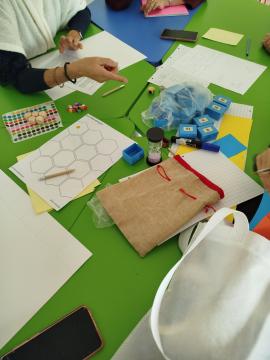
For this reason, the research I am conducting adopts a Teacher Action research design, known in Italy as Ricerca-Formazione (Asquini, 2018). This methodology aims to explore, together with teachers, how teaching practices must be adapted to work in different school contexts. Thereby, this research analyzes how community dynamics influence training and teaching processes and how the different contextual school conditions, lived by teachers, require a methodological fine-tuning of the GBL approach. Furthermore, I consider fundamental that the work with this community is not limited to training on theoretical models of GBL, but also promotes a direct experience of it. This allows for a concrete understanding of the training and learning potential of games. Therefore, I conducted a series of cooperative training sessions, designed to build a common basis on what it means to do GBL. The sessions included playing board games designed for training purposes, playing commercial off-the shelf board games that can be used in the classroom, observing other teachers while playing, designing and modding board games, designing GBL instruction and carrying out reflective discussions. This training approach derives from my previous research, in which I carried out Professional Development with different game-based strategies. Indeed, like other GBL trainers and researchers (Cantoia et al., 2024), I consider the principle of formative isomorphism fundamental (Baldacci et al., 2020): if I want to train teachers in the use of games, it is important that the methodologies of conducting the training are game-based as well.
Regarding my next steps, in a second phase of the research, throughout early 2026, the teachers of the community will implement their teaching designs based on GBL in their classes and will participate in periodic monitoring meetings that I will personally supervise, obviously while favoring peer exchange. At the end of each meeting, it will be my responsibility to provide a formative assessment to each teacher, giving individual and collective feedback, so that teachers feel supported in the process of professional growth. The collective comparison will allow, in particular, to address common emerging difficulties, so as to share strategies and solutions. The point of these monitoring processes is to observe how the practices of individual teachers of the community evolve over time in the hopes that these changes stand the test of time.
Beyond GBL
My Doctorate experience is not only focused on games, but has a broader scope, concerning the use of technologies for learning. This is also because this research project is funded by a scholarship from the Department of Excellence of the University of Milan Bicocca. This implies that I am affiliated to Capted (Departmental Center for Studies on Educational Changes and Potentialities in the digital transition). Hence, in addition to my research on games, I have been dealing, together with other researchers of the LISP center (Information Laboratory for Pedagogical Experimentation) with a research project on the perception of AI of university students of the Human-Computer Interaction degree course. Furthermore, I have been conducting a study, along with other doctoral students affiliated to Capted, to investigate Education Sciences university students’ Digital Competencies.
In conclusion, my hope is to collaborate with other researchers who specialize in promoting pedagogical change and, in particular, sustainable and meaningful ways to integrate games into primary school teachers' practices, so as to ensure they are finally ready to “get in the game".
Publications by Pier Daniel Cornacchia (Bicocca Open Archive)